
Why Your EV Charger Installation Might Require a Panel Upgrade
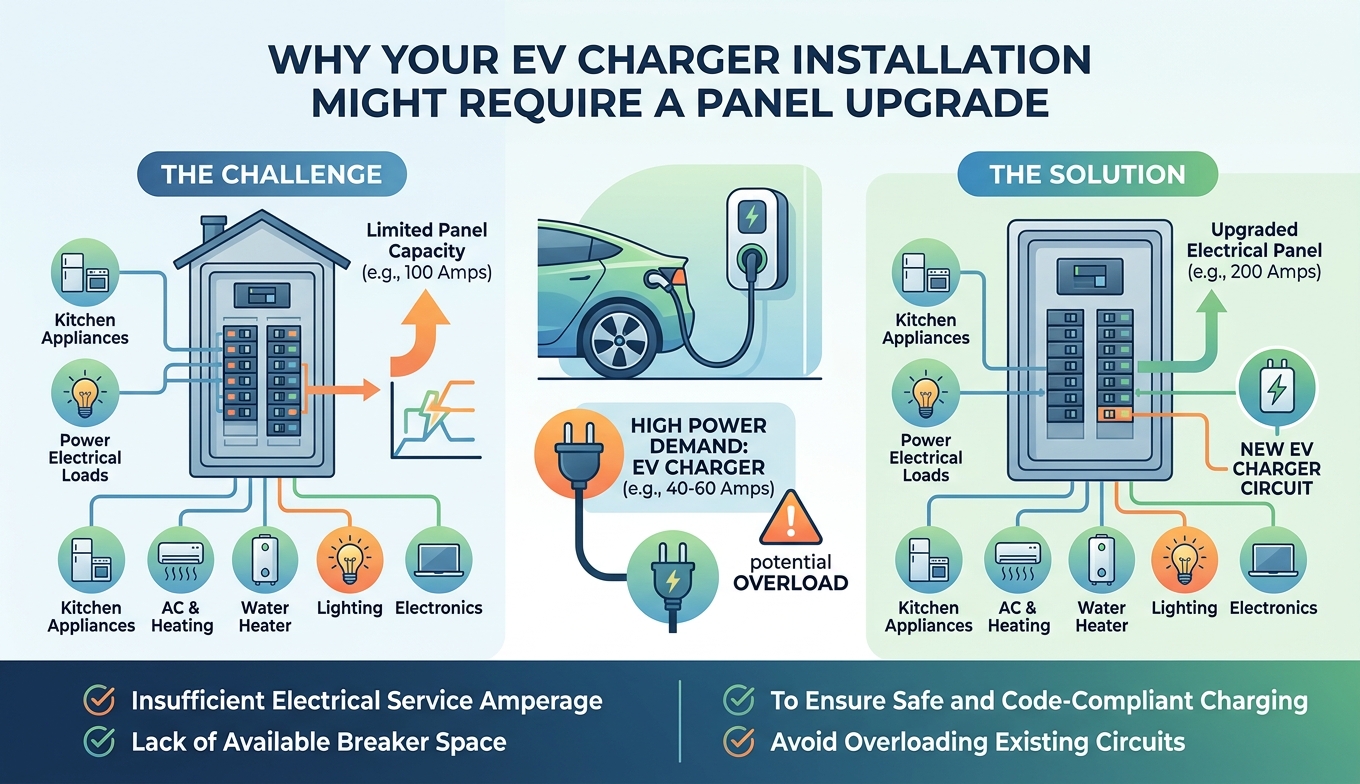
Why Your Nassau County Home Might Need a Power Boost for Your New EV
So, you’ve finally traded the gas pump for a charging cable. Congratulations! But before that sleek Level 2 charger goes on the garage wall, there’s a silent hero in your home that needs a check-up: your electrical panel.
In many Nassau County neighborhoods, especially those built before 1970, our homes weren't designed for the all-electric lifestyle. Installing a Level 2 charger is a bit like adding a second central AC unit; it’s a significant ask for an older electrical panel system.
Understanding Level 2 EV Chargers and Your Home's Electrical Panel
A standard Level 2 charger typically draws between 32 and 40 amps. While that sounds like just a number, consider this: many older homes in Hempstead or Oyster Bay operate on a 100-amp service.
Electrical codes generally recommend that your continuous load (the power you’re using) shouldn't exceed 80% of your panel's capacity.
If your home is already running a dryer, a refrigerator, and a few window AC units, you might already be hovering near that 80-amp limit. Adding a 40-amp charger isn't just a tight squeeze, it’s a recipe for frequent tripped breakers or overheating.
Smart Load Management
If a full panel upgrade (which can cost several thousand dollars) isn't in your budget right now, there is a modern solution: Smart Load Switching (or EVEMS).
The Secret Alternative: Instead of a massive construction project to upgrade your service line, you can install an Electric Vehicle Energy Management System (EVEMS).
This smart device monitors your home's total power usage in real-time.
If you turn on your clothes dryer and the oven at the same time, the EVEMS will automatically "pause" or slow down your car's charging until the other appliances are done. This allows you to safely run a Level 2 charger on a 100-amp panel without the risk of an overload. It’s a high-tech workaround that saves money while keeping your home perfectly safe.
What to Expect During the Process
-
The Load Calculation: A local electrician won't just look at the box; they’ll perform a load calculation based on your square footage and existing appliances.
-
The Utility Coordination: In Nassau County, if you do upgrade to 200 amps, your electrician will coordinate with PSEG Long Island to ensure the service line coming from the street can handle the jump.
-
The Installation: Once the "foundation" is solid, the charger installation itself is usually the quickest part of the day.
Why the Upgrade Matters
-
Safety First: Overloading a panel creates heat. Over time, this can degrade wire insulation and increase fire risks.
-
Future-Proofing: Upgrading to a 200-amp panel doesn't just solve your car charging problem; it prepares your home for heat pumps, induction stoves, or future additions.
-
Code Compliance: Nassau County inspectors are rigorous. A DIY or "under-the-radar" installation without a permit can lead to insurance headaches down the road.
Ready for a Professional Assessment?
Your EV is a piece of the future, but it relies on the infrastructure of the past. Getting a professional assessment ensures that your transition to electric driving is as smooth—and safe—as the car itself.
Call AVA Electrical at 516-582-8005 and schedule your assessment if you are considering an EV charger installation or see if your current panel can handle a Level 2 charger.